Draw What the Branch Reveals
Looking past the harvest: isolating the lanceolate leaves, flowering inflorescences, and woody stems of Mangifera indica with ink nibs and transparent watercolour.
The Architecture of Mangifera indica
In traditional botanical illustration, the fruit is merely the final punctuation of a complex seasonal cycle. The tree belongs to the family Anacardiaceae, known for leathery evergreen leaves and branching floral plumes. To render an authentic botanical plate, the illustrator must comprehend how each component originates along the branch.
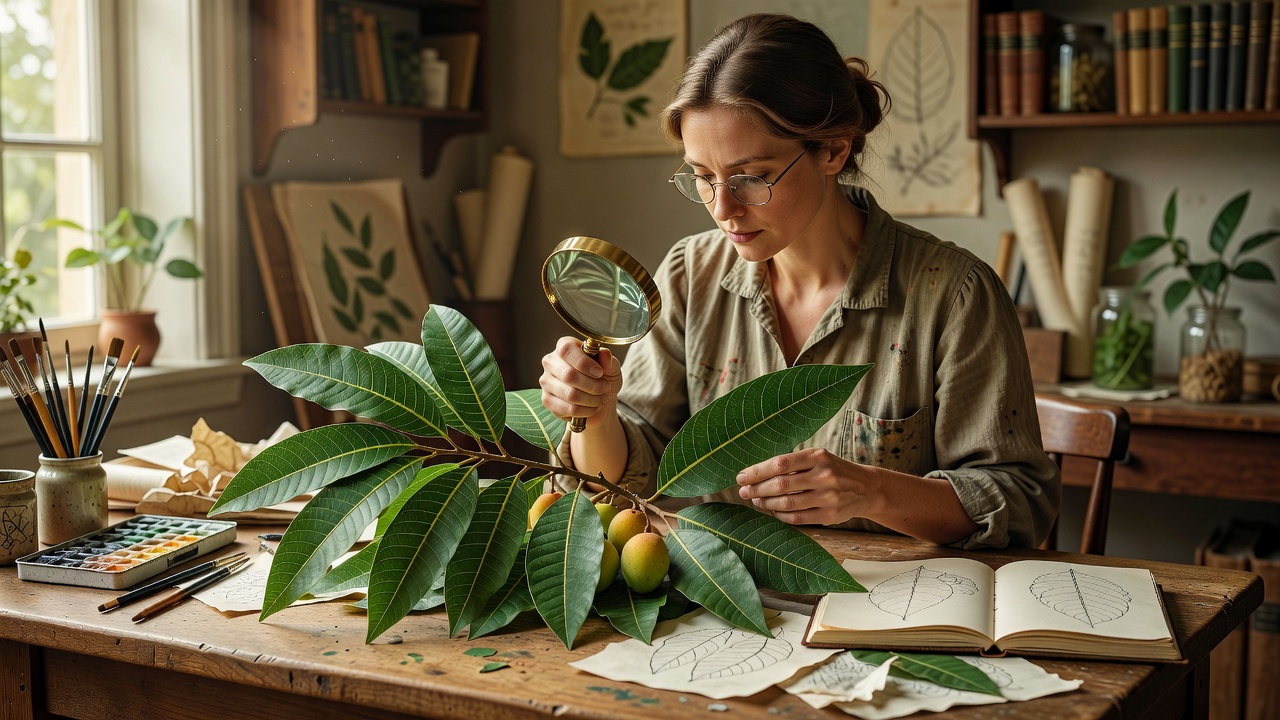
Mango leaves are spirally arranged along the branchlet, clustering densely near the tips. Their margins are distinctly undulate—waving slightly up and down rather than sitting perfectly flat. When drawing them, capture this gentle spiral motion; a straight, stiff leaf instantly robs the plate of natural vitality.
“Nature never draws a straight leaf. An authentic mango sprig curls like tanned leather drying under an afternoon monsoon sun.”
— Botanical Study Archive, Mangozuvir AtelierInking the Panicle and Miniature Florets
A single panicle can carry over four thousand individual florets, though only a tiny fraction will pollinate and swell into fruit. Attempting to depict every petal results in a congested visual smear. Instead, use disciplined selective focal rendering:
Line Density Hierarchy
Primary Axis (0.35mm Nib)
A decisive, tapered line for the woody central panicle stem, stippled with amber-brown ink to indicate bark texture.
Secondary Branchlets (0.20mm Nib)
Rapid, rhythmic strokes indicating the tiered lateral shoots that hold the floral buds.
Focal Blooms & Stippling (0.10mm Nib)
Select 3 to 5 blooms in full projection to detail five-lobed calyxes and prominent stamens. Let background clusters dissolve into airy stipple clusters.
Dissecting the Fibrous Stone
No botanical study plate is complete without a morphological dissection of the endocarp (the stone). Unlike a peach stone with its pitted, cratered surface, the mango stone is flattened and wrapped in dense, coarse woody fibers that anchor firmly into the surrounding flesh.
By scraping with a fine scalpel or dry-brushing pale ochre across dark raw umber, you can capture the longitudinal hair-like strands radiating outwards. This structural cross-section explains why the mango resists simple slicing and anchors the drawing in genuine plant science.