Compose the Fruit Bowl
How to arrange, light, and paint the subtle asymmetries of mangoes alongside artisan tableware, warm linens, and natural light sources.
The Weight of the Fruit
A mango never rests on a table like a symmetrical orange or an upright pear. Due to its off-center seed stone and uneven cheek flesh, it settles into an irregular diagonal tilt. Instead of fighting this leaning posture, master still life painters treat this axis as the primary dynamic vector across the canvas.
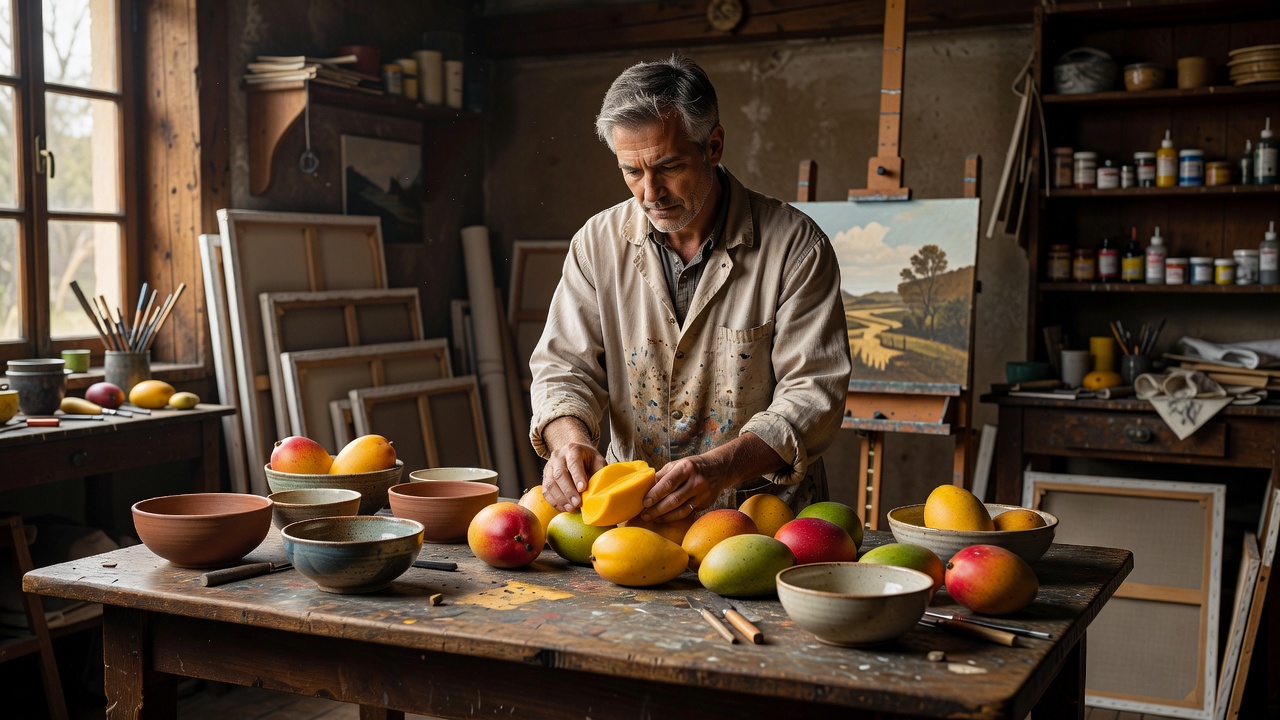
When composing your studio staging, place the dominant fruit cheek facing your key light. This exposes the gradual chromatic transition: a radiant gradient beginning at warm chrome yellow, sliding across burnt orange, and terminating in rich crimson blush on the sun-exposed shoulder.
“Do not treat the fruit bowl as a container; treat it as an amphitheater that redirects light into the underside of the mango.”
— Workshop Notes, Atelier Still Life SeminarVessels, Cutlery, and Tactile Counterpoints
To emphasize the slick, organic skin of the mango, surround it with materials possessing contrasting tactile qualities:
- Unglazed Stoneware: The gritty tooth of coarse clay grounds the fruit and creates soft, diffused edge penumbras.
- Aged Brass Blades: A patinated cheese or fruit knife injects sharp, geometric linear accents that guide the viewer’s gaze toward the stem scar.
- Frayed Vegetable Linen: Draping neutral linen beneath the bowl creates folded troughs of ambient shadow that cushion the fruit's vivid warmth.
Three-Stage Palette Mixing for Cast Shadows
Step 1: The Ambient Base
Avoid black and neutral gray. Mix burnt umber with a hint of deep forest viridian to establish a breathable, organic shadow core.
Step 2: The Reflected Warmth
Introduce yellow ochre and warm sienna into the shadow edge where the underside of the mango bounces light onto the tabletop.
Step 3: The Crisp Contact Occlusion
At the exact millimeter where skin presses paper or stoneware, place a sharp, dense stroke of deep raw umber to anchor mass.
Slicing the Narrative
Introducing an open cut fruit transforms the composition from a decorative display into an unfolding narrative of taste and interior anatomy. Cutting one cheek free exposes the fibrous halo surrounding the central pit, the juicy translucent glazes of the interior flesh, and the wet droplets clinging to the cut boundary.
Observe how the interior yellow is distinctly higher in chroma and lighter in value than the outer skin. Use semi-opaque gouache or oil glazes to render this radiant core without muddling your brushwork.